
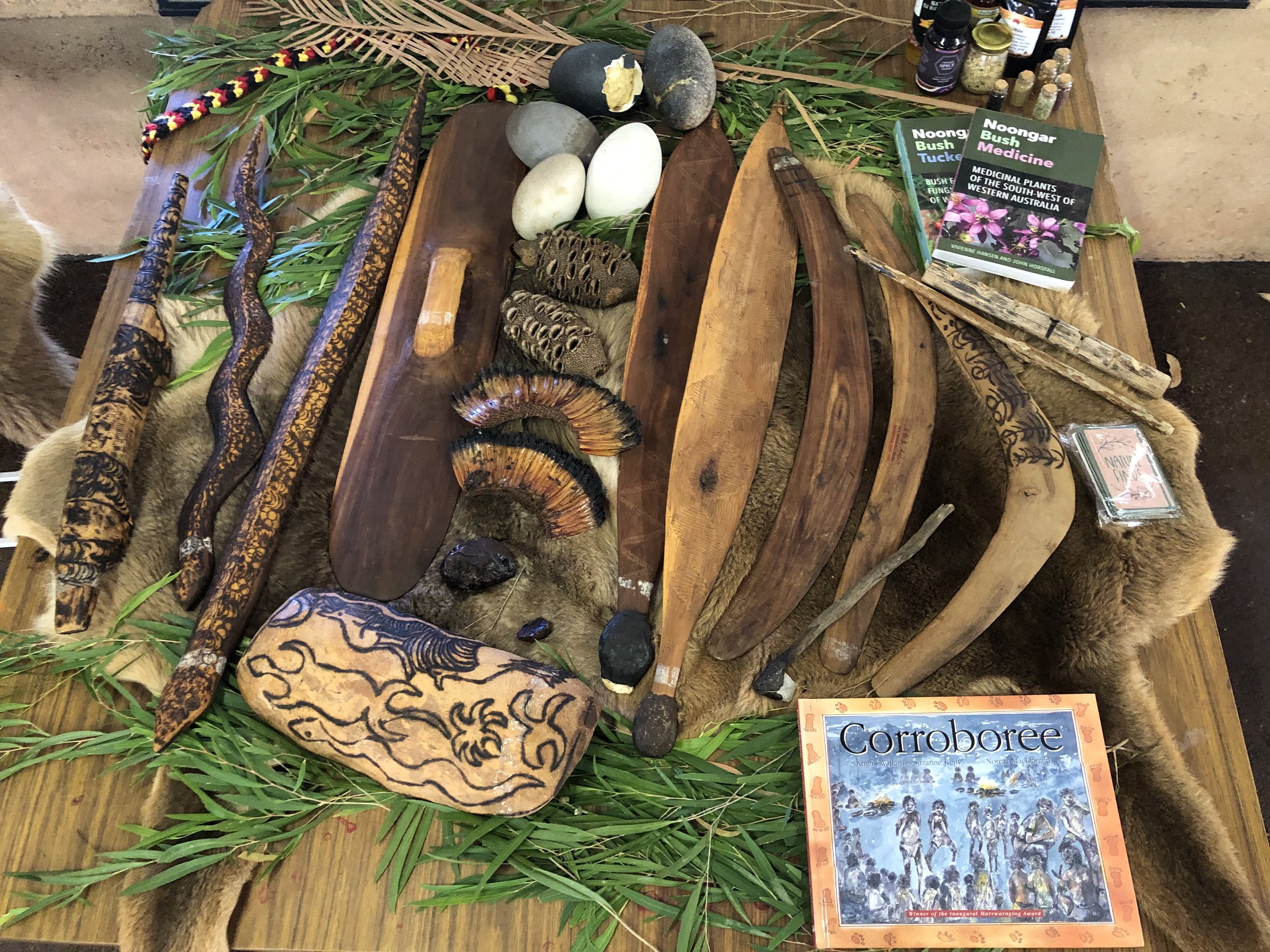
Noongar Culture
The Traditional Country of the Noongar people’s covers the entire south-western portion of Western Australia. This extends from Leeman in the north-west to beyond Cape Arid in the south-east. Archaeological evidence establishes that the Noongar people have lived in the area and had possession of tracts of land on their country for at least 45,000 years.
Noongar Seasons

-
The Noongar Season ‘Birak’ is represented by the colour red as it symbolises heat, sun and fire.
During Birak season the rain eases and the warm weather really starts to take hold. The afternoons are cooled by the sea breezes from the south west.
Traditionally this was the fire season. An almost clockwork style of easterly winds in the morning and sea breezes in the afternoon meant that this was burning time of the year for Noongar people and they would burn the country in mosaic patterns.
There are several reasons for this, including fuel reduction, increasing the grazing pastures for animals, to aid seed germination and to make it easier to move across the country.
There are many fledglings venturing out of nests in Birak, though some are still staying close to their parents such as magpies and parrots. Reptiles will also be shedding their old skin for a new one.
With the rising temperatures and the decreasing rainfall, it's also a time for the baby frogs to complete their transformation into adulthood.

-
The Noongar Season ‘Bunuru’ is represented by the colour orange and is the hottest time of the year.
Bunuru is the hottest time of the year with little to no rain. Hot easterly winds continue with a cooling sea breeze most afternoons – if you're close to the coast.
Traditionally this was, and still is, a great time for living and fishing by the coast, rivers and estuaries. Because of this, freshwater foods and seafood made up major parts of the Noongar people’s diet during Bunuru.
Bunuru is also a time of the white flowers with lots of white flowering gums in full bloom, including jarrah, marri and ghost gums.
Another striking flower to look out for is the female zamia (Macrozamia riedlei). Being much larger than its male counterpart, the huge cones emerge from the centre of the plant with masses of a cotton wool like substance.
As the hot and dry weather continues, the seed cones change from green to bright red, indicating they're ripening and becoming more attractive to animals, particularly the emu, that will eat the toxic fleshy outer layer.

-
The Noongar Season ‘Djeran' is represented by the colour green as it is the time of the year where the cooler weather begins.
Djeran season sees a break in the really hot weather. A key indicator of the change of season is the cool nights that bring a dewy presence in the early mornings.
The winds will also change, especially in their intensity, with light breezes generally swinging from southerly directions. Many flying ants can be seen cruising around in the light winds.
Djeran is a time of red flowers, especially from the red flowering gum (Corymbiaficifolia), as well as the smaller and more petite flowers of the summer flame(Beaufortia aestiva).
As you travel around the Perth area, you may also notice the red 'rust' and seed cones forming on the male and female she oaks(Allocasuarina fraseriana).
Banksias start to display their flowers,ensuring that there are nectar food sources for the many small mammals and birds that rely upon them.
Traditionally, foods at this time of year included the zamia seeds that had been collected and stored for treatment during the previous season.
The root bulbs of the yanget (Bullrushes),fresh water fish, frogs and turtles were also common foods.
As the season progresses, the nights will become cooler and damp. The onset of cool and rainy days meant that traditional mia mias (houses or shelters) were repaired and updated to make sure they were waterproofed and facing in the right direction in readiness for the deep wintery months to come.

-
The Noongar Season ‘Makuru’ is represented by the colour dark blue as it symbolises rain and cold weather.
Makuru sees the coldest and wettest time of the year in the South West. Traditionally, this was a good time of the year to move back inland from the coast as the winds turned to the west and south bringing the cold weather, rains and occasionally snow on the peaks of the Stirling and Porongurup Ranges.
As the waterways and catchments started to fill, people were able to move about their country with ease and their food sources changed from the sea, estuarine and lake foods to those of the land, in particular the grazing animals such as the kangaroo.
As well as a food source, animals provided people with many other things. For example, the 'yongar' or kangaroo, not only provided meat but also 'bookas' (animal skin cloaks that were used as the nights became much cooler). Nothing was left. Even the bones and sinews were used in the manufacturing of bookas and for affixing barbs to hunting tools such as spears.
Makuru is also a time for a lot of animals to be pairing up in preparation for breeding in the coming season. If you look carefully, you might see pairs of 'wardongs' (ravens) flying together.
Upon the lakes and rivers of the South West, you'll also start to see a large influx of the Black Swan or 'Mali' as they too prepare to nest and breed.
Flowers that will start to emerge include the blues and purples of the blueberry lily (Dianella revoluta) and the purple flags (Patersonia occidentalis).
As the season comes to a close, you should also start to notice the white flowers of the weeping peppermint (Agonis flexuosa) as the blues start to make way for the white and cream flowers of Djilba.

-
The Noongar Season ‘Djilba' is represented by the colour pink as it symbolises growth of wildflowers and plants.
This is the start of the massive flowering explosion that happens in the South West. Beginning with the yellow flowering plants such as the acacias.
Djilba is a transitional time of the year, with some very cold and clear days combining with warmer,rainy and windy days mixing with the occasional sunny day or two.
Traditionally, the main food sources included many of the land-based grazing animals including the yongar (kangaroo), the waitj (emu) and the koomal (possum).
As the days start to warmup, we start to see and hear the first of the newborns with their proud parents out and about providing them with food, guiding them through foraging tasks and protecting their family units from much bigger animals, including people!
The woodland birds are still nest bound, hence the swooping protective behaviour of the koolbardi (magpie), djidi djidi (willy wag tails) and chuck-a-luck (wattle birds).
As the season progresses and the temperatures continue to rise, the flower stalks of the balgas (Grass Trees) emerge in preparation for the coming Kambarang season.

-
The Noongar Season ‘Kambarang' is represented by the colour yellow as it symbolises the return of the hot weather.
During Kambarang season,we see an abundance of colours and flowers exploding all around us.
The yellows of many of the acacias continue to abound, along with some of the banksias and many other smaller delicate flowering plants including the kangaroo paw and orchids.
During this time the balgas will continue to flower, especially if they've been burnt in the past year or closely shaved.
One of the most striking displays of flowers to be seen during this season will be the moojar, or Australian Christmas Tree (Nuytsia floribunda). The bright orange-yellow flowers serve to signal the heat is on its way.
October is also the most likely time of the year that you'll encounter a snake as the reptiles start to awaken from their hibernation and look to make the most of the warm to assist them in getting enough energy to look for food.
It's also a time that many young families of birds will be singing out for their parents to feed them. Koolbardies (magpies) will be out protecting their nests and their babies.
Many things are undergoing transformation with the warm change in the weather and longer dry periods accompany a definite warming trend.
Noongar Language
The Noongar people are one of the largest Aboriginal cultural blocks in Australia. There is no evidence that there has been any other group than Noongar in the South West. Noongar are made up of fourteen different language groups (which may be spelt in different ways): Amangu, Yued, Whadjuk, Bindjareb, Wardandi, Ballardong, Nyakinyaki, Wilman, Ganeang, Bibulmun, Mineng, Goreng, Wudjari and Njunga. Each of these language groups correlates with different geographic areas with ecological distinctions.

Noongar Words
nidja/yimniny
this/here
djerabiny
happy
kaya
hello
wanju
welcome
kaartdijin
knowledge/learn
yira yaak
stand up
nyininy/nyin
sit
nih
listen
Noongar people speak their own language and have their own laws and customs. Those laws and customs were characterised by a strong spiritual connection to ‘country’; caring for the natural environment and for places of significance; performing ceremonies and rituals; collecting food by hunting, fishing and gathering; providing education and passing on law and custom through stories, art, song and dance.

While the effect of European settlement has been profound , many significant aspects of Noongar Culture and society have been retained and are still practised by the Noongar people.
For more information on Noongar culture, visit the Kaartdijin Noongar (Noongar Knowledge) page on the South West Land And Sea Council website